
Mandatory Caravan Towing Licences
Disclaimer: This article is intended for general informational and educational purposes only. It does not constitute legal, regulatory, or professional
Mandatory Caravan Towing Licences Read More »

What do Compliance Frameworks mean to everyday Australian vehicle owners?
Firstly, What Is a Compliance Framework?
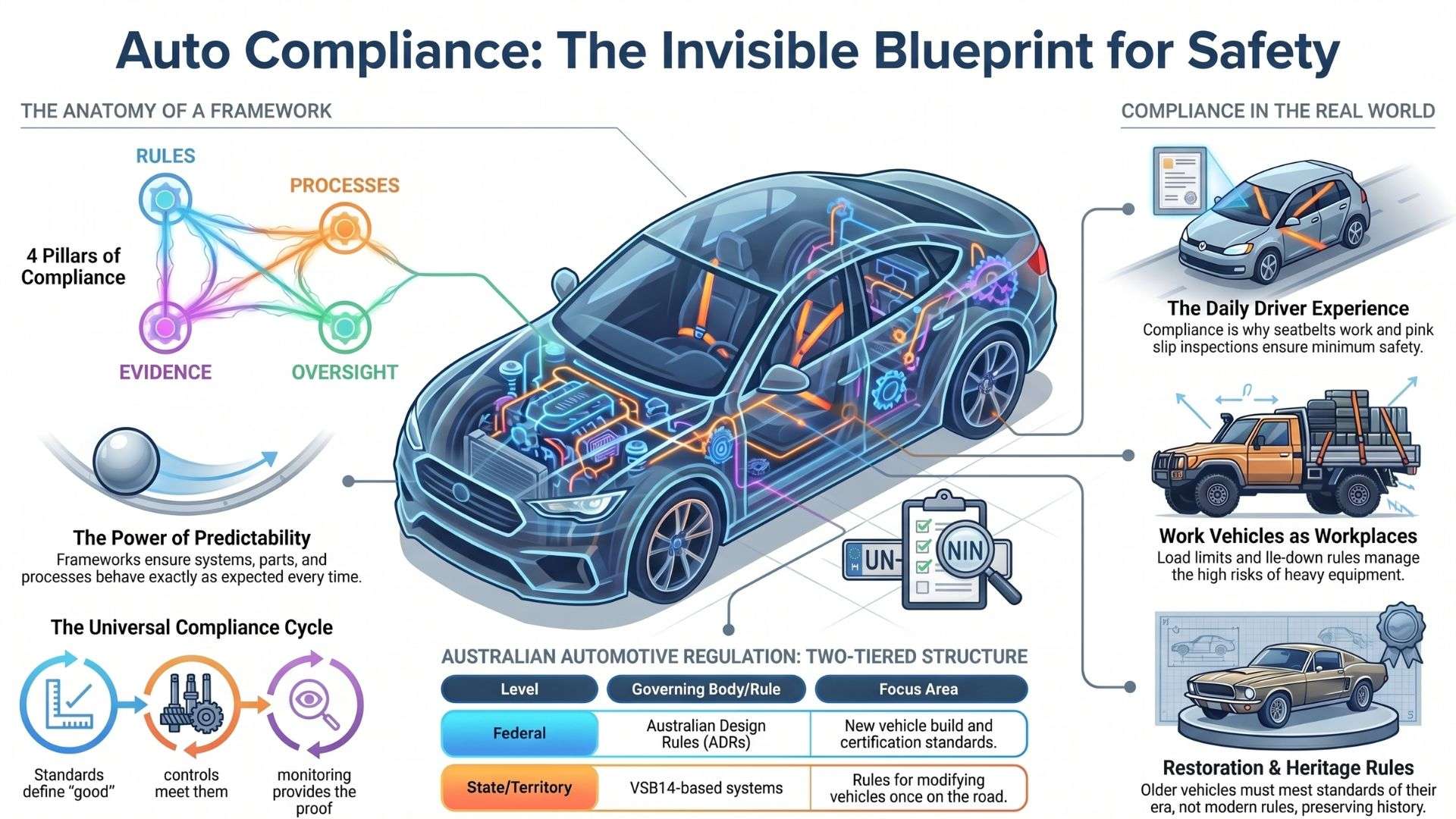
A compliance framework is typically the combination of four things:
Together, these elements create a structure that keeps everything predictable, safe and aligned with expectations.
Why Do Compliance Frameworks Exist?
Compliance frameworks serve several important purposes:
These are genuinely useful things to have in place, which is why compliance frameworks appear across industries like aviation, construction, finance, healthcare and automotive manufacturing.
The Key Idea: Predictability
The most important concept in any compliance framework is predictability. It ensures that:
Predictability is the foundation of safety, reliability and public confidence.
How Are Compliance Frameworks Structured?
Most frameworks follow a similar pattern:
This structure is universal, whether you are dealing with a bank, a hospital, a factory or a vehicle manufacturer.
Why Does This Matter for Vehicles?
Even though the term sounds bureaucratic, compliance frameworks are the reason:
The framework is invisible, but it shapes everything.
What Is The Shape of Auto Compliance in Australia?
In Australia, vehicle compliance operates across two levels:
These layers work together even though most drivers never see them directly. You feel them when you buy a car that already has a compliance plate. You feel them again when you take a vehicle in for a pink slip inspection. The structure is invisible but always present.
A simple example is the way headlights are aimed. The rules specify angle and brightness so that oncoming drivers are not dazzled.
You do not need to know the numbers, only that the rules exist so that night driving feels consistent across the country.
The same logic applies to seatbelt anchorage points, brake performance and side-impact behaviour. These are not abstract ideas.
They are the reason a daily driver feels familiar even when it is ten years old and has endured Australian summers of harsh UV.
The counterintuitive part is that compliance is not only about safety. It is also about interoperability.
A vehicle built to the rules can be repaired with parts that match the original intent. That is why a mechanic in a small regional town can work on an imported car without needing custom instructions.
The framework creates a shared language across the entire industry.
Compliance and the Daily Driver
For most Australians, the daily driver is a tool (a tool in the average persons toolbox of life).
It gets people to work, carries kids to school and sits in the sun outside the shops. Compliance affects this routine more than people realise.
The registration system, inspection requirements and maintenance expectations all stem from the same framework.
When a pink slip inspector checks tyre tread depth, they are not making a personal judgement, they are applying a standard that exists so every car on the road meets a minimum level of predictability.
There is a sensory detail many drivers recognise without thinking about it. When you close the door of a well-maintained, compliant vehicle, the sound is solid. It is not the hollow rattle of a car that has been poorly repaired.
That sound is the result of structural integrity rules governing how panels must be attached and how the cabin must behave in a collision. You do not need to know the rule number. The sound tells you something about the vehicle’s condition all by itself.
A practical trade-off appears as a daily driver ages. The rules do not change, but the vehicle does. Rubber hardens in the heat. Plastics fade under UV.
Suspension bushings soften. The framework expects the vehicle to remain within its original performance envelope, but the owner must decide how much maintenance is reasonable.
Replacing worn components keeps the vehicle aligned with its compliance baseline. Ignoring them slowly moves it away from the behaviour the rules assumed. Maintenance costs money and time and every owner must balance both while keeping the vehicle predictable.
Work Vehicles and the Weight of Responsibility.
Work vehicles occupy a different category. In my opinion, a tradesperson’s ute or van is not only a mode of transport, it is a mobile workplace.
Compliance frameworks recognise this by adding layers of responsibility.
Load limits, tie-down requirements and equipment mounting rules exist because a work vehicle carries more than tools. It carries risk when used outside its design envelope.
The Australian climate adds another dimension. A ute loaded with gear on a hot day behaves differently from the same ute on a cool morning.
Tyre pressures rise. Brakes heat faster. Suspension works harder on corrugated gravel roads.
When a tradesperson overloads a tray by a few hundred kilograms, the vehicle may still move, but it no longer behaves as the rules intended.
The steering feels heavier. The rear end sags. Braking distance increases. These physical sensations are reminders that the framework is being stretched. One detail that often goes unnoticed: many work vehicles carry ladders on roof racks. The wind noise from a poorly positioned ladder can be heard at suburban speeds.
That noise is not just an annoyance, it is a sign that the load is affecting aerodynamics in a way the original design did not account for.
Compliance frameworks cannot cover every scenario, but they assume loads are secured and positioned sensibly. The noise is a cue to check the setup.
Restoration and the Return to Original Glory.
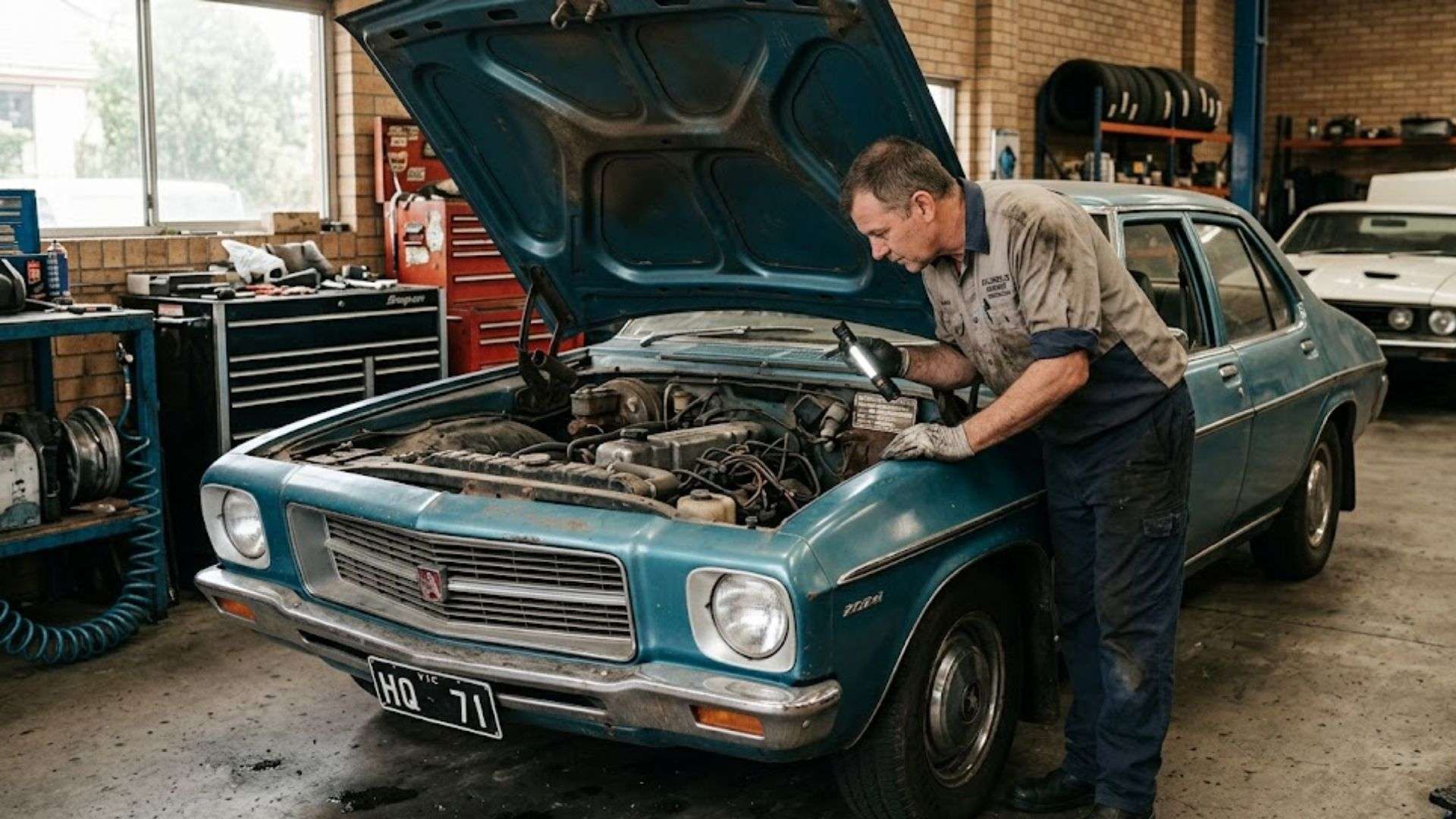
A full restoration brings compliance into sharp focus. Restorers typically aim to return a vehicle to its original condition, which means working within the rules that applied when the vehicle was new.
The compliance plate becomes a key reference point. It records the build date, the vehicle category and the standards the vehicle met at the time. Restoring a classic Falcon or Holden to its original specification is not only an act of preservation, it is an act of alignment with the framework that once governed the vehicle.
The sensory experience of restoration is distinct from daily driving. You feel the weight of old metal panels.
You smell primer drying in a shed warmed by afternoon sun. You hear the click of original switches designed decades before modern electronics.
These details matter because they connect the vehicle to its compliance era. A restorer who understands the framework can make decisions that respect the original design without compromising roadworthiness.
Importantly, older vehicles are not required to meet modern standards, they must meet the standards of their time.
This surprises many people who assume all vehicles must comply with current rules. The framework recognises history. It allows older vehicles to exist as they were, while still requiring them to be roadworthy.
This balance keeps heritage alive without forcing modernity onto machines that were never designed for it.
Restomods and the Blend of Old and New
A restomod sits between restoration and modern engineering. It keeps the character of an older vehicle while adding contemporary components.
This creates a unique compliance challenge. The vehicle must still meet registration requirements, but each modification must be engineered to ensure predictable behaviour.
A modern engine in a classic body changes weight distribution. New brakes alter stopping characteristics. Updated suspension changes ride height and geometry. Every change interacts with the framework.
The Australian climate shapes restomod decisions in particular ways. Heat management becomes critical when fitting modern powertrains into older engine bays. Dust and gravel roads test suspension upgrades.
UV exposure affects paint and plastics. A restomod built for Australian conditions must consider these factors, even when the original design did not. The practical limitation restomod builders face is documentation. Engineering certificates, modification plates and inspection reports all become part of the process, adding cost and time.
The trade-off is that a properly engineered restomod feels cohesive. The steering weight matches the power output.
The brakes match the speed. The suspension matches the roads. The framework ensures the vehicle behaves as a unified whole, rather than a collection of mismatched parts.
Why Compliance Matters More Than People Think
Compliance frameworks are not about restriction. They are about consistency. They allow a daily driver to feel predictable after years of use. They allow a tradesperson’s ute to carry tools safely.
They allow a restored classic to return to the road with dignity. They allow a restomod to blend eras without losing coherence.
Understanding compliance does not require memorising rules. It only requires recognising that the framework exists to keep vehicles aligned with their intended behaviour.
When you feel the steering tighten on a hot day, or hear a ladder whistle on the roof rack, you are experiencing the edges of that framework.
When you restore a classic or build a restomod, you are working within it. When you maintain a daily driver, you are preserving it.
Compliance is not distant. It is woven into the way Aussies use their vehicles every single day.
Disclaimer: This article is intended for general informational and educational purposes only. It does not constitute legal, regulatory, or professional
Mandatory Caravan Towing Licences Read More »

Disclaimer: The content of this article reflects the author’s personal views, thoughts, and ideas only. It is provided for general
A Comprehensive Guide to Car Headlights Read More »

Disclaimer: The content of this article reflects the author’s personal views, thoughts, and ideas only. It is provided for general
Essential Safety Tips for Night Driving Read More »

Disclaimer: The content of this article reflects the author’s personal views, thoughts, and ideas only. It is provided for general
15 Essential Vehicle Ownership Tips Read More »

Disclaimer: The content of this article reflects the author’s personal views, thoughts, and ideas only. It is provided for general
Varying Driver Visibility Between Vehicles Read More »

Disclaimer: The content of this article reflects the author’s personal views, thoughts, and ideas only. It is provided for general
SUV Visibility Consideration is Crucial Read More »
Disclaimer: The content of this article reflects the author’s personal views, thoughts, and ideas only. It is provided for general
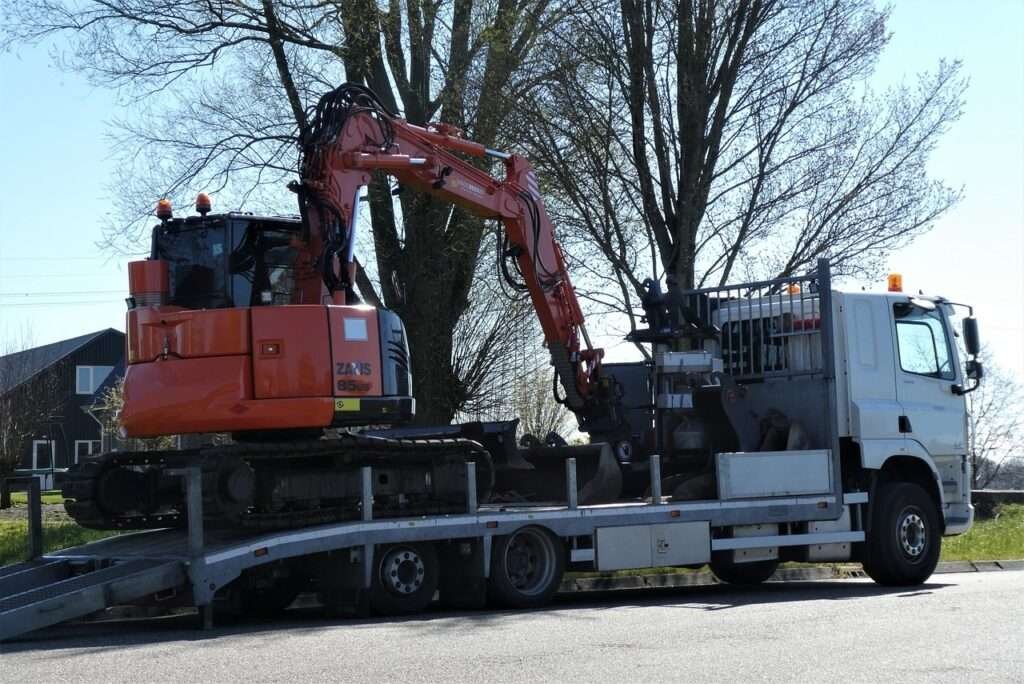
Work Vehicle Insurance Read More »

Disclaimer: The content of this article reflects the author’s personal views, thoughts, and ideas only. It is provided for general
2023 Subaru Forester Hybrid S Tyres Read More »
Disclaimer: The content of this article reflects the author’s personal views, thoughts, and ideas only. It is provided for general
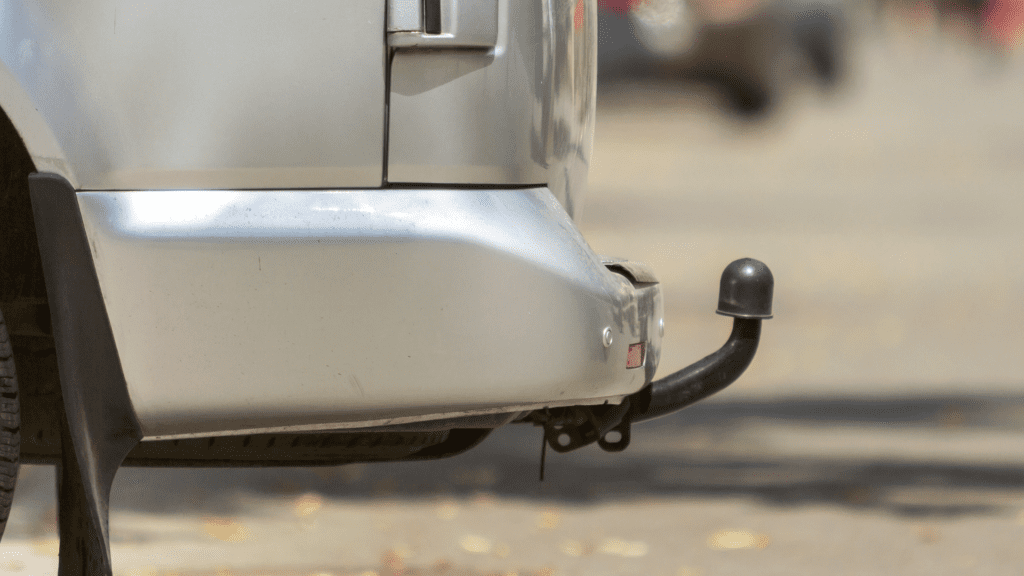
Is It Worth Getting A Towbar installed Read More »

Is it worth getting car window tinting? As the temperature rises and the sun shines brighter, it’s time to consider
Is Car Window Tinting Worth The Money Read More »

Disclaimer: The content of this article reflects the author’s personal views, thoughts, and ideas only. It is provided for general
Is It Worth Buying Roof Racks Read More »

Disclaimer: The content of this article reflects the author’s personal views, thoughts, and ideas only. It is provided for general
What Tools Should I Pack In The Trunk Of My Car Read More »

Disclaimer: The content of this article reflects the author’s personal views, thoughts, and ideas only. It is provided for general
Vehicle Rooftop Cargo Bags & Boxes Read More »

Disclaimer: The content of this article reflects the author’s personal views, thoughts, and ideas only. It is provided for general information
Give your CAR’S paint job a birthday Read More »

Disclaimer: The content of this article reflects the author’s personal views, thoughts, and ideas only. It is provided for general
Scratched or dented your first car? Read More »
Disclaimer: The content of this article reflects the author’s personal views, thoughts, and ideas only. It is provided for general information
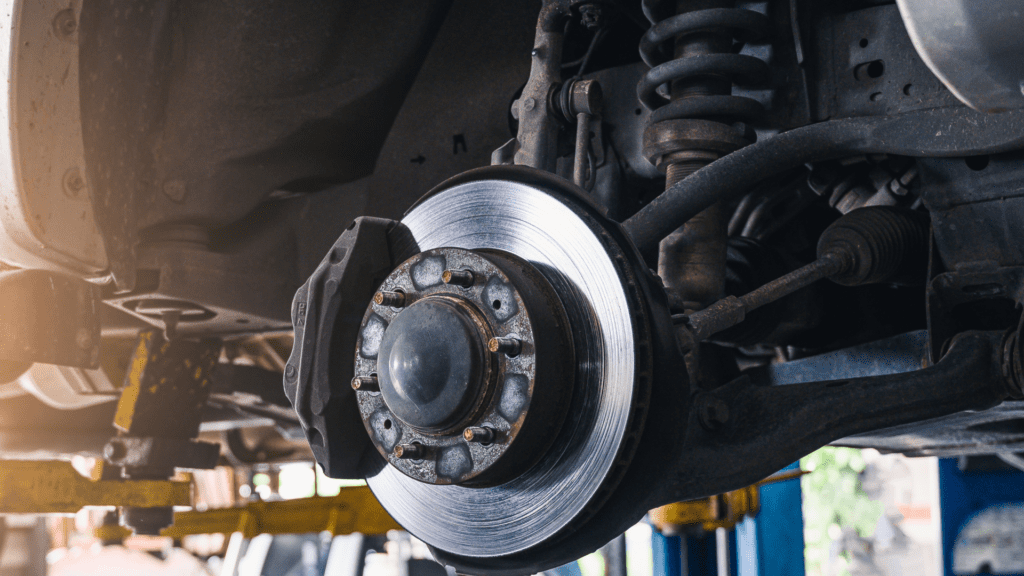
Your brakes, steering & suspension Read More »

Disclaimer: The content of this article reflects the author’s personal views, thoughts, and ideas only. It is provided for general information
Replace engine or vehicle Read More »

Disclaimer: The content of this article reflects the author’s personal views, thoughts, and ideas only. It is provided for general
Quality Headlights might save your life Read More »